







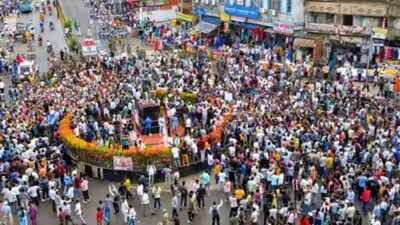
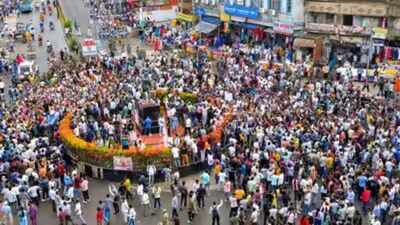
NEW DELHI: From protests over examination irregularities and electoral rolls to debates over caste, education and government policies, students have returned to the streets, raising questions that extend far beyond university campuses. The recent demonstrations in Delhi have once again put student organisations and their leaders in the national spotlight.In October, student activists joined demonstrations demanding the resignation of Chief Election Commissioner Gyanesh Kumar over alleged irregularities in the Special Intensive Revision (SIR) of electoral rolls. The protests brought together student groups, political activists and Opposition leaders, turning a dispute over electoral processes into a wider political confrontation.Among those who gained attention was Neha Bora, national president of the All India Students’ Association (AISA). Images of Bora being pursued by police in Connaught Place and her subsequent appearance alongside Rahul Gandhi and Priyanka Gandhi Vadra during the October 12 march towards the Supreme Court showed how quickly campus activists could move into the national political conversation.But Bora is only one example of a much older phenomenon. Across political ideologies, student organisations have helped mobilise protests, shaped political debates and produced leaders who later entered Parliament and state assemblies.The question is whether today’s student movements can have a similar impact, and how effectively they can represent students while navigating national party politics.
When student protests became political movements
Student politics in India has a history stretching back to the freedom struggle. Established in 1936, the All India Students’ Federation (AISF) was among the earliest nationwide student organisations. After Independence, campuses remained important spaces for political mobilisation.One of the most significant examples came during the Bihar student movement of the 1970s. Protests against corruption, inflation and misgovernance expanded under Jayaprakash Narayan into a mass political movement challenging the Congress government.The movement and the Emergency of 1975 shaped a generation of political leaders. Lalu Prasad Yadav, Nitish Kumar, Sushil Kumar Modi and Ravi Shankar Prasad were among those whose early political careers were influenced by the student activism of that period.Student politics also opened doors for leaders from different political backgrounds. Former Union minister Arun Jaitley and Congress leader Ajay Maken served as Delhi University Students’ Union (DUSU) presidents. Delhi chief minister Rekha Gupta began her political journey through the Akhil Bharatiya Vidyarthi Parishad (ABVP).Jawaharlal Nehru University (JNU), meanwhile, produced Left leaders such as Sitaram Yechury and Prakash Karat. Kanhaiya Kumar, who gained national attention during the 2016 JNU controversy, later joined the Congress.These examples show that student politics has not been limited to one party or ideology. For many leaders, campuses provided their first experience of elections, public speaking, organisation and political debate.
DUSU and JNU: Where political careers begin
Delhi University and JNU remain important centres of student politics, although their political cultures differ.At Delhi University, elections are largely contested between the RSS-affiliated ABVP and the Congress-backed National Students’ Union of India (NSUI).In the 2026 DUSU elections, ABVP won three of the four central panel posts, with Yash Dabas elected president, Riya Chhawdi secretary and Lakshya Raj Singh joint secretary. Independent candidate Deepanshu Shokeen, a former NSUI member, won the vice-president’s post.The results reflected the continuing influence of national political organisations in campus elections, as well as the ability of independent candidates to challenge them.JNU has traditionally been a stronghold of Left student groups, including AISA and the Students’ Federation of India (SFI), although ABVP has also made electoral gains.In 2025, ABVP won the JNUSU joint secretary post and secured 24 of 46 councillor positions in one election. Later that year, the Left Unity alliance swept the central panel, with Aditi Mishra becoming president.Such elections give students experience in political mobilisation, but they also raise questions about whether national party rivalries overshadow concerns about fees, hostels, scholarships and campus infrastructure.
From Mandal to Assam: When campuses shaped policy
Some student movements have influenced debates well beyond university politics.The implementation of the Mandal Commission’s recommendation for 27% reservation for Other Backward Classes (OBCs) in central government jobs triggered widespread protests in 1990. The anti-Mandal movement exposed deep divisions over reservation, merit and social justice.In 2016, the death of University of Hyderabad research scholar Rohith Vemula led to nationwide protests over caste discrimination and institutional accountability.Student organisations also played important roles in regional movements.In Assam, the All Assam Students’ Union (AASU) led the six-year agitation against alleged illegal immigration that ended with the Assam Accord in 1985. Former AASU leader Prafulla Kumar Mahanta subsequently became chief minister.In Tamil Nadu, student participation in the anti-Hindi agitations of the 1960s helped strengthen the movement against the Congress establishment and brought language politics to the centre of the state’s political debate.Students at Osmania University were also active during the movement for a separate Telangana, particularly between 2009 and 2014.More recently, students from Jamia Millia Islamia and Aligarh Muslim University participated in protests against the Citizenship Amendment Act in 2019. At Jadavpur University, the Hokkolorob movement of 2014-15, which followed protests over an alleged molestation case and police action, ended with the resignation of vice-chancellor Abhijit Chakrabarti.The issues and outcomes differed, but these movements demonstrated how student mobilisation could influence public debate, government decisions and political leadership.
What should student politics actually achieve?
Despite its connections with national politics, the primary purpose of student unions remains representation within educational institutions.Dr Ashok Sharma, a former JNU student leader, says universities have a responsibility beyond academic learning.“Universities are not merely centres of academic learning; they are also spaces where young people develop political awareness, leadership qualities, democratic values and a sense of social responsibility,” he says.According to Sharma, elected student representatives must also focus on the everyday concerns of students.“Elected representatives have a mandate to raise issues involving academic policies, fees, scholarships, accommodation, campus infrastructure and administrative decisions,” he says.However, the close links between student organisations and national political parties can complicate their responsibilities.“Many student groups have ideological or organisational affiliations with national political parties, which is not necessarily undesirable because political engagement is part of democratic life. However, problems arise when the priorities of parent political parties overshadow students’ academic, administrative and welfare concerns,” Sharma says.The challenge, therefore, is not simply to produce future politicians but to ensure that campus politics continues to serve students.
The limits of campus politics
Concerns over money, violence and political interference have also shaped how student elections are conducted.The Lyngdoh Committee, appointed in 2005, recommended reforms including eligibility requirements and campaign spending limits. Its recommendations, accepted by the Supreme Court in 2006, set a spending ceiling of Rs 5,000 per candidate.Implementation has differed across universities. Allahabad University, for example, moved from direct student union elections to a student council system in 2019. Supporters argue that such arrangements can reduce disruptions, while critics say they weaken direct student representation.Sharma cautions that student politics should not interfere with education.“Excessive politicisation, intimidation, vandalism and prolonged disruptions can undermine academic activities and damage institutional credibility,” he says.There is also the question of whether visibility on protest platforms translates into sustained political influence. Many student leaders enter mainstream politics, but not all succeed in building careers beyond their campuses.
What recent movements tell us about student power
The growing visibility of student leaders in India’s recent protests comes at a time when student activism is also influencing politics elsewhere.In Serbia, protests began after the collapse of a railway station canopy in Novi Sad in November 2024 killed 16 people. Students demanded accountability and organised demonstrations that developed into a broader movement against the government.On October 25, 2026, the student-backed Student List won the country’s parliamentary election, with preliminary official results giving it over 52% of the vote. The outcome followed nearly two years of demonstrations and showed how sustained student mobilisation could develop into electoral political power.
Share your thoughts in the comments
Be respectful · TOI community guidelines
Serbia’s experience is not directly comparable with India’s, where student organisations have long-standing links with established political parties. But it shows that movements beginning with specific grievances can develop into wider campaigns.In India, the latest protests have once again brought student leaders into the national conversation. Whether they eventually enter electoral politics or remain activists, their immediate test lies in representing the concerns that brought students together in the first place.Student politics has produced chief ministers, MPs and national leaders. Its larger significance, however, lies in giving young people a platform to question decisions, demand accountability and participate in public life, while ensuring that their educational concerns do not get lost in party politics.