










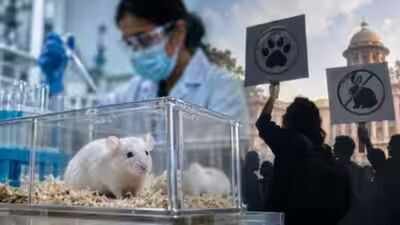
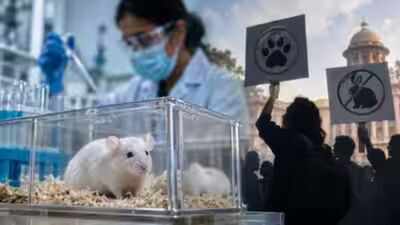
NEW DELHI: The use of laboratory animals in medical research could face tighter restrictions, with draft rules requiring researchers to explore alternatives to live animals wherever scientifically possible, minimise their numbers and reduce pain and suffering. The proposals also seek to prohibit experiments involving severe suffering that is likely to be prolonged and cannot be alleviated.In a public notice issued on Monday, the National Medical Commission (NMC) asked Deans, Principals and Heads of medical colleges and institutions to submit their comments, objections and suggestions to the Committee for Control and Supervision of Experiments on Animals (CCSEA) within 30 days. The draft rules were notified on September 30 and published in the Gazette of India on October 6.The rules place the principles of replacement, reduction and refinement at the centre of animal research. They classify experiments as non-recovery, mild, moderate and severe, and prohibit those likely to cause prolonged, severe suffering that cannot be alleviated.Veterinary supervision would be mandatory for all experiments, with every establishment involved in animal research or breeding required to appoint a veterinarian. Each establishment would also have to set up a nine-member Institutional Animal Ethics Committee, with a three-year tenure, to oversee experiments. The committee would include scientists, a biologist, a veterinarian and four CCSEA nominees, and meet at least twice a year.
Share your thoughts in the comments
Be respectful · TOI community guidelines
The draft also seeks to avoid death as an experimental endpoint wherever possible, requiring researchers to use early humane endpoints. Where death is unavoidable, the number of animals affected and the duration and intensity of suffering must be minimised. Establishments would have to maintain records of euthanasia, including the method, dosage and reason.The use of stray and feral domestic animals would be restricted, with exceptions allowed only when their use is scientifically justified. Experiments on non-human primates would be permitted only for narrowly defined research purposes where no other species can serve the objective.All establishments conducting animal experiments or breeding, housing and trading laboratory animals would require CCSEA registration and face inspections at least twice a year. Violations could invite a 15-day notice to rectify deficiencies, followed by suspension or cancellation for repeated non-compliance. Immediate action would be allowed in cases of imminent risk to animal welfare.