









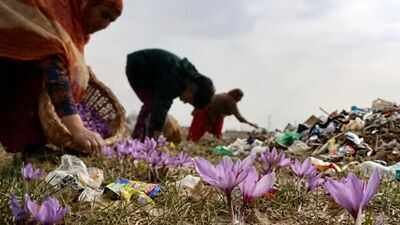
SRINAGAR: National Green Tribunal (NGT) has constituted a committee of experts to assess environmental damage and inspect a municipal dumping site in J&K’s Pampore after an activist filed a petition alleging such waste disposals were threatening the area’s vast saffron fields.The NGT division bench of Justice Prakash Shrivastava and Afroz Ahmad directed the committee to submit a report in eight weeks. The order, passed recently, comes at a time when saffron cultivation has fallen nearly 35% over the years, posing serious challenges for farmers. Saffron, locally known as kesar, is believed to have originated in southern Europe but is now widely cultivated in Iran, Spain and Turkey. In India, it is primarily grown in Pampore.The NGT-formed panel will include representatives of Sher-e-Kashmir University of Agricultural Sciences and Technology of Kashmir (SKUAST-K), to be nominated by its vice-chancellor, regional director of the Union environment ministry and a nominee of the J&K Pollution Control Committee.The members visit the Pampore site, in Pulwama district, find out the extent of municipal and plastic waste dumped there and ascertain if necessary clearances have been secured. “The committee will also ascertain the effect of dumping of the waste upon the crop,” the order states.In his NGT plea, environmental activist Raja Muzaffar Bhat has alleged that Pampore’s municipal body was illegally dumping harmful materials at its solid waste management facility in Patlibagh-Galander area.Untreated waste was generating leachate that was seeping into underground water sources and flowing through channels into the Jhelum river, located less than 1km away, Bhat’s plea says.The dumping site is located in a notified saffron-growing area protected under Saffron Act, 2007, attracting rodents and porcupines which further damage crops, Bhat’s plea says. He submitted with his petition a report by the local pollution control officer about “heaps of unsegregated and untreated waste, including single-use plastic items and packaging materials”. “Apart from this site, they are using saffron fields for dumping municipal waste,” Bhat told TOI.
Share your thoughts in the comments
Be respectful · TOI community guidelines
Saffron cultivation has declined around 35% from 5,707 hectares in early 2000s to 3,715 hectares a decade later. Productivity also plunged. However, govt says the decline has been checked since 2010-11 when a Rs 400-crore Saffron Mission was started. Farmers dispute the claim.