







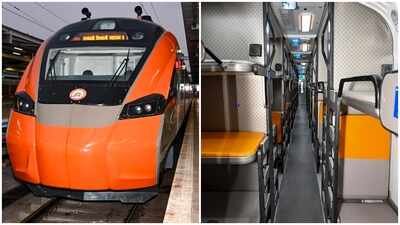
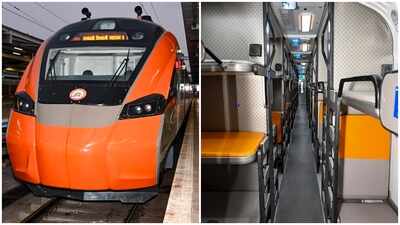
2026 has been a milestone year for Indian Railways with the introduction of the Vande Bharat sleeper train services. Vande Bharat sleeper trains have been put into service so far on three routes.A few days ago, the Vande Bharat sleeper trains were launched on the Delhi-Varanasi and Mumbai-Bengaluru routes. Earlier this year, the first Vande Bharat sleeper train was introduced between Howrah and Guwahati.Vande Bharat sleeper trains are fully air-conditioned overnight train services that have been designed to offer superior comforts to Rajdhani Express trains, while also reducing travel time with higher average speeds.
More Vande Bharat sleeper trains soon
Indian Railways has given BEML the contract to manufacture 10 Vande Bharat sleeper trains to begin with. Six out of these have been manufactured and the remaining four are being made.Sources told TOI that two more rakes are expected to be rolled out this month and the other two will be ready in the coming two months.BEML has also been tasked with manufacturing an additional three rakes of Vande Bharat sleeper trains for which the process of procuring the necessary supplies and raw materials has started.Meanwhile, BEML is also manufacturing India’s first high-speed bullet train for the Mumbai-Ahmedebad bullet train corridor. A section of this stretch is expected to become operational in the second half of 2027.
Vande Bharat Sleeper Trains
Developed for long-distance journeys, the Vande Bharat Sleeper aims to bring together modern technology, enhanced safety features and passenger-oriented facilities to improve the experience of travelling overnight. Its design aims to make extended journeys more comfortable, with a focus on sleeping arrangements, hygiene, security, accessibility and convenience.The train can run at speeds of 180 kmph and has been cleared for 160 kmph speeds, though the maximum speed on each route depends on the sectional clearance.Passenger comfort and convenience have also been considered in the design. The train features ergonomically designed, odour-free toilets with vacuum evacuation, along with dedicated berths and toilets for differently-abled passengers.Modern passenger amenities and spacious luggage storage areas are provided to make long journeys more convenient. Integrated BRL units come with a three-pin charging socket and switch, while Type A and Type C USB ports offer additional charging options.In terms of power and performance, the train incorporates regenerative braking to improve energy efficiency, along with an under-slung propulsion system. Its advanced aerodynamic design is intended to support smoother acceleration and deliver a ride with minimal jerks.The train’s design features include an austenitic stainless steel car body that meets EN15227 crash standards. It has a fully sealed flexible gangway fitted with a quick-release mechanism, while centrally controlled single-leaf automatic sliding plug doors provide access between the train and its surroundings.Noise insulation and mitigation measures are intended to create quieter passenger saloons. The interiors also feature direct and indirect LED lighting, as well as sensor-based intercommunication doors.Safety and security provisions include compliance with EN45545 HL3-grade fire safety standards and fire barrier doors at the end walls. The train is equipped with a Train Collision Avoidance System (TCAS), disaster management lighting and a smoke and fire detection system (FDS). CCTV cameras support safety and passenger surveillance, while emergency push buttons allow passengers to raise an alarm when required.A PAPIS-based communication system enables interaction among the driver, guard and passengers. First AC passengers have access to showers with hot water. The train also includes a Wi-Fi router with an access point network, while the driver’s cab is air-conditioned and crew members have access to a dedicated toilet.Indian Railways has also awarded the contract for manufacturing 50 Vande Bharat sleeper trains with more coaches to ICF. Additionally around 200 Vande Bharat sleeper trains with 16 coaches are being made by Kinet and Titagarh Wagons.