









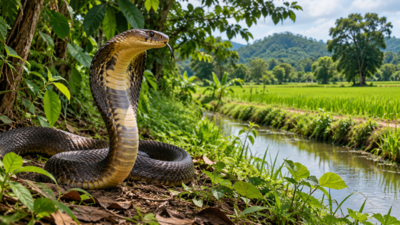
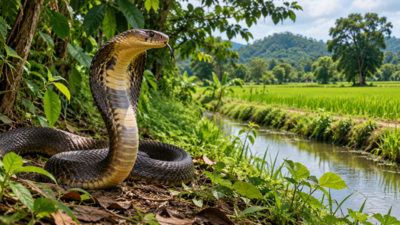
Farmland, roads and new settlements are spreading across the world, and wildlife is left to find its way through landscapes that people have reshaped. In northeastern Thailand, a study of king cobras, among the largest venomous snakes on Earth, shows what that looks like up close. Seven cobras tracked at the Sakaerat Biosphere Reserve moved less in agricultural areas and leaned on patches of natural vegetation, especially along irrigation canals. Broken-up landscapes, it seems, can hold animals back even when they live right beside people.
Why are king cobras moving less through agricultural landscapes in Thailand
According to the study published in Movement Ecology, titled ‘No room to roam: King Cobras reduce movement in agriculture, ’ researchers conducted the work in Sakaerat Biosphere Reserve, Nakhon Ratchasima province, northeastern Thailand. The landscape includes a protected forest core, a buffer zone being reforested, and a transitional zone used for rice, corn, and sugar cane. That farmed zone also holds 159 villages and a four-lane highway linking Nakhon Ratchasima to Bangkok, so wildlife habitat sits right next to farming and transport infrastructure.Seven king cobras were tracked between 22 March 2014 and 28 July 2018, with their locations logged around four times a day. Radio transmitters were implanted while the snakes were under anaesthesia, and positions were worked out by triangulation. The team tried to keep at least 10 metres away from the animals as they tracked them. Movement generally rose in forested areas but tended to fall in agricultural landscapes.
Why do king cobras rely on natural vegetation in farmland
Cobras crossing farmland kept their movements to vegetated semi-natural areas. These were scrub and vegetation that was not actively farmed, often found along field margins, irrigation canals and disused plots. The researchers singled these areas out as important because they gave the snakes routes through farmland where suitable natural habitat had been broken up.Not every snake reacted to the landscape in the same way. Some individuals were linked with semi-natural vegetation, while others showed different patterns around roads, settlements and other features. The researchers also noted that vegetation and water may offer cover and potential prey, though they did not measure directly whether prey was more plentiful there. The findings point to the value of remaining natural vegetation, but they do not suggest that every king cobra uses farmland in the same way.
How do roads and villages affect king cobra movement
Roads and human settlements can expose king cobras to threats such as vehicle collisions and conflict with people. Even so, the researchers found no consistent evidence that the snakes avoided them. The animals kept using available habitat patches, even close to roads or settlements. The study also recorded that the snakes spent an average of 2.3 days at shelter sites and returned to places they had used before roughly every 13 days. The researchers found no consistent link between distance to landscape features and either the time snakes spent at shelter sites or how often they went back. They also reported wide variation in how long individual snakes spent in human-disturbed areas. Across the tracked animals, it ranged from 0.7 per cent to 100 per cent of the tracking period, which underlines how differently individual king cobras used the landscape.
How can forest corridors and irrigation canals protect king cobras
The researchers concluded that irrigation canals and forest fragments may help king cobras persist in agricultural areas cut off from protected forests. They said future conservation research should focus on how these links are kept in place and how threats to the snakes can be reduced. The paper also suggested that road-crossing structures combined with fencing could help with the danger roads pose.The study stressed that king cobras are vulnerable outside protected areas, where they can face direct and indirect human-caused mortality. The researchers also pointed to the need to reduce persecution of the snakes and improve humane snake-removal services. They cautioned that their findings rest on a small sample of seven individuals, whose movement patterns differed. The results cannot be assumed to represent all king cobra populations across their range.